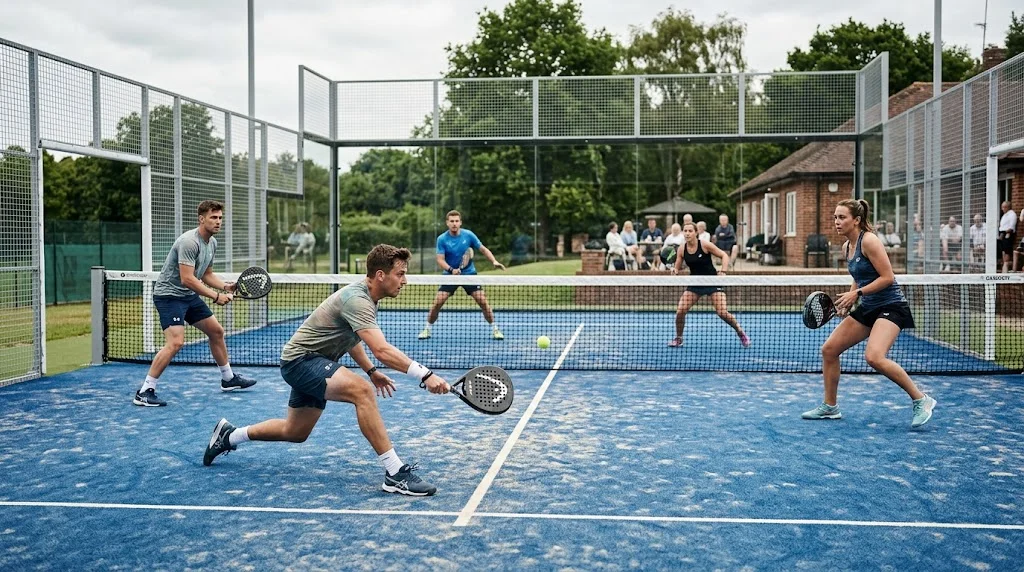
Padel Rules UK: The Complete Guide to Playing and Scoring
Padel is currently the fastest-growing racket sport across Great Britain. New courts are opening every week in community sports centers, private fitness clubs, and converted tennis spaces from London to Edinburgh. While the enclosed glass court makes the game friendly for beginners, navigating the official regulations can lead to confusion. Understanding standard padel rules uk ensures that every match remains smooth, competitive, and fair.
Governed domestically by the Lawn Tennis Association (LTA) and internationally by the International Padel Federation (FIP), padel combines elements of tennis and squash. However, it functions under a distinct regulatory code. Here is your definitive reference guide to playing, scoring, and mastering the sport.
Essential Overview: What Is Padel and How Does It Work?
Padel is exclusively played as a doubles sport featuring four players on court. While singles practice courts exist at select facilities, official matches across clubs and tournaments require pairs. The fundamental objective is to hit the ball over the net into the opponent’s side, keeping rallies alive through tactical positioning, wall rebounds, and calculated ball placement.
Core Court Dimensions and Inactive Boundary Lines
A regulation court measures 20 meters long by 10 meters wide, enclosed on all four sides by a combination of reinforced tempered glass panels and metal mesh fencing. The net spans the center, hanging 88 centimeters high in the middle and rising slightly to 92 centimeters at the lateral posts.
Court markings differ significantly from tennis. The court features service lines positioned 6.95 meters from the net and a perpendicular center service line. These painted markings exist solely to organize the serve. Once a rally begins, all lines become inactive. Boundaries are defined strictly by the net and the surrounding walls, meaning players do not need to check sidelines during open play.
Legal Rackets, Lower Pressure Balls, and Mandatory Wrist Straps
Padel equipment is engineered specifically for enclosed play. Instead of traditional strung frames, players use solid composite bats without strings, commonly built with carbon fiber or fiberglass faces perforated with holes. These bats cannot exceed 45.5 centimeters in total length. Beginner rackets typically feature round heads with centralized sweet spots, while advanced players favor teardrop or diamond shapes for elevated power.

A critical safety regulation requires every player to keep the non-elastic safety cord around their wrist. Stepping onto the court without this lanyard securely fastened is an immediate violation under official regulations.
The balls look nearly identical to standard tennis balls but operate at lower internal pressure, typically between 4.6 and 5.2 kilograms per 2.54 square centimeters. This reduced pressure lowers the rebound height, keeping the ball manageable within enclosed glass walls. Using regular tennis balls in official competition is strictly prohibited.
Padel Serve Rules: Execution, Footwork, and Recent Updates
The serve initiates every point and serves as the primary source of procedural faults for beginners. Unlike tennis, where players strike from above their heads, the serve in padel must be hit underarm.
The Step-by-Step Legal Underarm Serve Sequence
To execute a legal serve, you must follow this exact order:
-
Stand comfortably behind the service line, staying between the imaginary extension of the center service line and the side glass.
-
Drop the ball onto the artificial turf and allow it to bounce once. You cannot strike the ball out of the air or toss it upward like a tennis serve.
-
Strike the ball at or below your waist level.
-
Direct the ball cross-court so it clears the net and lands cleanly inside the opponent’s diagonal service box.
As in tennis, the server gets two attempts per point. A fault on the first serve permits a second attempt, while a fault on the second serve hands the point directly to the receiving pair.
Service Box Landing and Wall vs Mesh Contact
Once the ball bounces cleanly inside the correct service box, wall contact determines whether play continues:
-
In Play: If the ball bounces in the box and then strikes the back glass or side glass, the serve is valid and the receiver must return it.
-
Service Fault: If the ball bounces in the box and subsequently strikes the metallic wire mesh fence before a player hits it, the serve is an automatic fault.
-
Out: If the serve strikes the ground outside the designated service box lines, hits the net without landing in the box, or strikes any wall on the full, it is an immediate fault.
Foot Faults and the 2026 Serve Line Ruling
Footwork during the serve is closely monitored. Under current regulations, the server must keep at least one foot in contact with the ground behind the service line at the exact moment of racket contact. Jumping serves and stepping onto or over the painted white line prior to striking the ball constitute foot faults.
Recent updates from the FIP also clarify the trajectory of the ball prior to contact. The ball may not cross the service line or the center service line in the air before being struck. Players must bounce and hit the ball entirely within their designated serving quadrant.
Replaying the Point: The Net Cord Let Rule
If a served ball clips the top tape of the net cord, travels across, and bounces cleanly into the opponent’s service box, a let is called. The serve is replayed without penalty.
However, if a clipped serve lands inside the service box and subsequently hits the wire mesh fence on its first rebound, it is considered a service fault rather than a let. If it clips the net, bounces in the box, and strikes the back or side glass, the let remains valid and the serve is taken again.
How the Walls Work: Glass Rebounds, Wire Mesh, and Legal Shots
Mastering the enclosure is what makes padel uniquely addictive. The walls are not boundaries that stop play; they are active surfaces that extend rallies.
The Floor-First Principle
The fundamental golden rule of wall play is that the ball must bounce on the turf before touching any wall on the opponent’s side. If an opponent hits a ball that strikes your glass wall, side fence, or wire mesh directly without first bouncing on the court floor, their shot is out, and you receive the point immediately.
Playing Off Your Own Back Glass
When defending deep drives, you are legally permitted to strike the ball directly against your own glass walls so that it rebounds over the net into the opponent’s court. This technique is often used to execute defensive lobs when trapped deep in the corner.
This allowance applies strictly to the glass. You are never permitted to hit the ball off your own metallic wire mesh fence. Doing so results in an immediate loss of the point.
Dealing with Unpredictable Cage Rebounds in Active Rallies
While the wire mesh causes a fault on the serve, it remains fully active during general rallies. Once a ball bounces legally on your opponent’s side of the court, hitting the side mesh creates an unpredictable, irregular rebound that is exceptionally challenging to defend. Learning to react to balls kicking sharply off the metal grid is a core developmental milestone for competitive players.
Padel Scoring System: Traditional Sets, Golden Point, and Star Point
The scoring structure in padel mirrors the traditional tennis framework, utilizing the classic sequence of 15, 30, 40, and game. A team starts at love (zero) and needs to win four points with a two-point margin to secure a game.
Matches are typically contested across a best-of-three-sets format. To secure a set, a pair must win six games with a two-game advantage. If the score reaches 5-5, the set can be won at 7-5. If games reach 6-6, a standard tiebreak is played.
Punto de Oro: The Golden Point in Social and Club Matches
When a game reaches 40-40 (deuce), traditional rules call for advantage play, requiring one team to win two consecutive points. However, many British clubs and competitive circuits prefer the Golden Point system, known internationally as Punto de Oro.
Under Golden Point rules, reaching 40-40 triggers a single sudden-death point to determine the game winner. The receiving pair holds tactical authority, choosing whether the server must deliver the final ball into the left or right service box. This rule speeds up match lengths, ensuring games fit neatly into typical 60-minute court booking slots.
The 2026 Star Point System in Competitive Play
For higher-tier tournaments, the FIP introduced the Star Point system. Under this framework, the first two instances of deuce are contested using traditional advantage scoring. If the score returns to deuce for a third time, that third deuce becomes a sudden-death Star Point. Just like the Golden Point, the receiving team chooses the side for the final delivery, providing a balance between competitive tradition and broadcast scheduling.
Deciding Sets with Tiebreaks and 10-Point Super Tiebreaks
When games reach 6-6 in any standard set, a 7-point tiebreak is played. Points are counted numerically (1, 2, 3), and the first pair to reach seven points with a two-point cushion claims the set.
In casual club settings or recreational box leagues, organizers often substitute a full third set with a 10-point match tiebreak (super tiebreak). In this format, the first team to reach 10 points with a two-point advantage wins the entire match, saving time and energy while keeping competition high.
Faults, Infringements, and Direct Point Deductions
Understanding how to keep points alive is equally about knowing what actions forfeit a point instantly. Familiarity with fundamental padel rules uk protects you from conceding unnecessary points over common technical errors.
Net Contact Penalties
Touching the net is strictly prohibited under all circumstances. If a player touches the net, its support posts, the tension cable, or any part of the net structure with their body, clothes, or racket while the ball is live, they forfeit the point immediately. Even if you hit a clean winner, touching the net on your follow-through hands the point to your opponents.
Reaching Over the Net and the Single Legal Exception
As a general rule, you cannot reach across the net to hit a ball on the opponent’s side of the court. Contact must be made on your own side.
There is one notable exception to this rule. If an opponent hits a shot with heavy backspin or smashes the ball off your back glass such that it bounces on your turf and spins or flies back over the net by itself, you are legally permitted to reach over the net to strike the ball downward before it bounces on the other side according to padel rules uk. However, your body and racket must still avoid touching the net cord.
Double Hits, Carries, and Dropping the Racket
Hitting the ball twice in a single motion constitutes a fault if deliberate. An accidental, continuous redirection on a single swing is generally accepted, but carrying the ball on the racket face loses the point.
Furthermore, if a player accidentally drops their racket or the wrist strap snaps mid-rally, the point is automatically awarded to the opposing team.
Advanced Gameplay: Out of Court Play and Special Shots
Once players transition beyond basic rallying, padel introduces unique vertical and external dimensions rarely found in other sports.
Running Out of the Cage (Salida de Pista)
In professional arenas and specialized British facilities built with at least two meters of external clearance around the doorways, out-of-court play is permitted.
When an attacking player smashes the ball into the turf so hard that it rebounds out over the four-meter back wall (a smash known as por cuatro) or over the three-meter side fence (por tres), a defending player can sprint out through the side door. If they strike the ball from outside the enclosure and return it over or through the door before its second bounce, the rally remains live.
Defensive and Offensive Tactical Shots: Bandeja, Vibora, and Bajada
As you refine your approach within standard padel rules uk, your shot selection will evolve beyond basic groundstrokes:
-
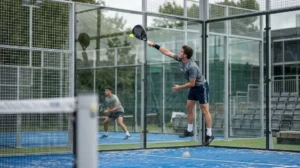
The Bandeja: An overhead defensive slice hit softly with an open racket face. It keeps the ball low into the opponent’s back corners without giving them an easy rebound off the glass.
-
The Vibora: An aggressive, side-spun overhead aimed toward the side mesh to produce a skidding, unpredictable sideways trajectory.
-
The Bajada: An aggressive downward drive executed after the ball rebounds high off your back glass wall, turning defense into attack.
Padel rules uk vs Tennis Rules:
Many players picking up padel arrive with a background in tennis. While tactical instincts and hand-eye coordination carry over, several primary differences must be kept in mind:
| Feature | Padel | Tennis |
| Court Size | 20 meters by 10 meters, fully enclosed | 23.77 meters by 10.97 meters, open space |
| Match Format | Doubles only | Singles and Doubles |
| Serve Style | Underarm after a ground bounce | Overarm hit out of the air |
| Enclosing Walls | Live and playable after a floor bounce | Out of bounds |
| Boundaries | Lines matter only for the serve | Lines mark active boundaries throughout |
| Racket Construction | Solid composite bat with holes, no strings | Hollow frame with strung mesh bed |
| Out of Court Play | Allowed at venues with approved exits | Not permitted |
Observing these core differences helps tennis converts avoid instincts like running backpedaling to track a high lob, instead allowing the ball to bounce off the rear glass where it can be handled comfortably.
Social Match Etiquette and UK Weather Realities
While the official rulebook sets technical boundaries, practical social habits keep games running smoothly across British courts.
LTA Self-Umpiring and Disputed Point Resolution
The vast majority of games played in the UK are self-umpired. Under LTA recommendations, the pair on whose side the ball bounces is responsible for calling lines and out balls.
If there is genuine doubt or disagreement between pairs regarding whether a ball clipped the wire mesh or cleared the glass, the standard etiquette is to avoid prolonged arguments and replay the point on a let. Additionally, the server should call the score out loud before each serve to prevent confusion.
Playing on Wet Outdoor Courts padel rules uk
Given the unpredictable British climate, outdoor court conditions require extra consideration. Playing on damp artificial grass with sand infill is common, but wet glass alters play completely:
-
The Glass Slide: When water coats the glass panels, balls do not bounce up and forward. Instead, they skid straight down toward the turf upon impact.
-
Ball Weight: Padel balls absorb moisture quickly, becoming heavier and reducing bounce height.
-
Tactical Adjustment: On wet outdoor courts, attacking players should focus on driving low slices into the back glass, where rebounds become virtually unreturnable.
Matches should be paused if heavy rain creates standing water puddles on the turf, as water pooling ruins ball movement and creates slip hazards for moving players.
FAQs
Can you play singles padel under official LTA padel rules uk?
Official tournament and competitive matches governed by the LTA are conducted exclusively in a doubles format. While dedicated narrow singles courts exist for training, full-size court competitions require four players.
What happens if the ball hits the top metal frame of the court?
If the ball hits the horizontal top metal frame above the glass or mesh, it is considered out. The ball must strike the playing surfaces of the glass or wire mesh within the court perimeter.
Can the ball hit the wire mesh fence after bouncing in the court?
During open rallies, yes. A shot that clears the net, bounces on the opponent’s artificial turf, and then rebounds off the side wire mesh remains fully live. It is only considered a fault when this sequence occurs directly off a serve.
What happens if the ball strikes an opponent’s body regarding padel rules uk?
If a hit ball touches an opposing player or any part of their clothing before bouncing on the turf, the team that struck the ball wins the point immediately, regardless of where the player was standing.
Do I have to let the ball bounce before hitting a volley?
During regular rallies, you can volley the ball directly out of the air anywhere on your side of the net. The only strict exception is the return of serve: the receiver must always let the served ball bounce once inside the service box before striking it.
By adhering to these standard padel rules uk, you can step onto any local court with total confidence, avoid common disputes, and fully enjoy one of the most exciting sports in the country.








Post Comment