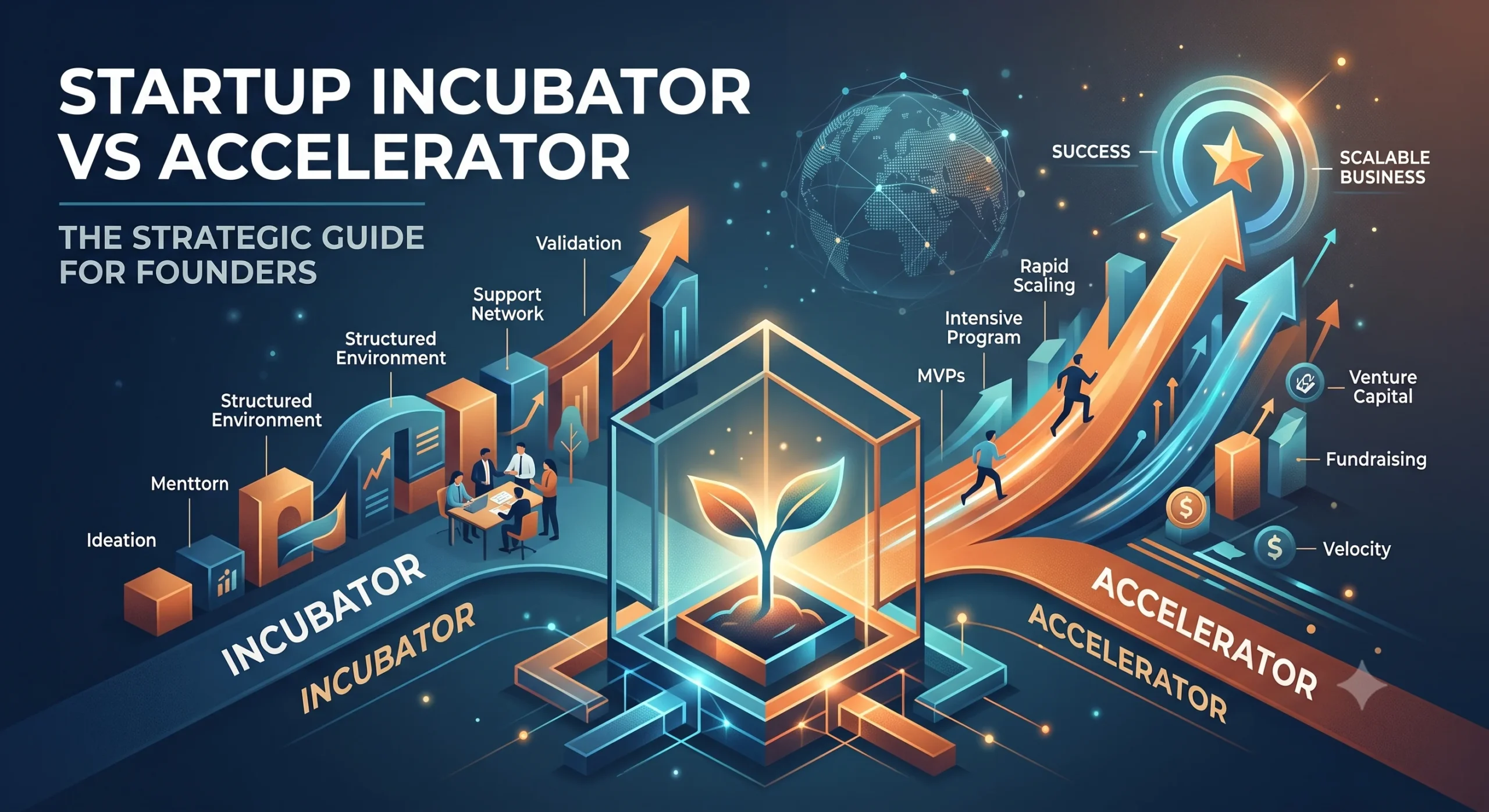
Incubator vs Accelerator: The Strategic Guide for Founders
If you want to transform a novel concept into a scalable company, joining one of the top modern business incubator can provide the essential funding, mentorship, and office space your startup needs to survive its initial years. Starting a new business is an exhilarating journey. However, early-stage founders face steep learning curves and financial hurdles. If you want to transform a novel concept into a scalable company, you must evaluate proper development frameworks. Fortunately, specialized hubs can help your business survive the critical initial years.
Among the most popular choices are distinct community ecosystems commonly known as incubators. These organizations provide the foundational support that early-stage ventures need to validate their models.
Nevertheless, entering this ecosystem requires a clear understanding of program operations. Selecting the wrong environment can cost you valuable time and equity. Therefore, this comprehensive guide breaks down the modern landscape of corporate, university, and niche business hubs. Ultimately, these insights will help you leverage available resources to scale your venture successfully.
Understanding the Business Incubator Program Model
To fully appreciate what these hubs offer, you should understand their history. The core concept originally began over sixty years ago to stimulate local economic growth. Originally, these programs simply offered low-cost workspaces to small businesses. Over the decades, that basic approach evolved into a highly structured environment. Today, modern industrial incubators act as an operational springboard for innovation.
So, how do these setups work in practice? While every program has its own unique structure, they generally bring a community of founders together. When you join, you receive access to physical office space, utilities, and shared equipment. More importantly, these programs offer structured guidance and direct accountability. Instead of navigating legal compliance alone, you work alongside experienced development professionals. These mentors keep you focused on the right way to grow.
The Micro-Niche Shift: Beyond General Business Incubators
As the global startup ecosystem matures, the market is moving away from generalized support. Today, we see a massive shift toward highly specialized hubs. Choosing a niche-focused tech startup space or specific biotech incubators can give your company a massive competitive edge. This advantage exists because the underlying infrastructure fits your exact product type.
-
University Startup Incubators: Academic institutions often work with their students to develop high-potential ideas. These university programs provide safe environments where founders can run experiments and access advanced labs.
-
Corporate Startup Incubators: Major corporations build internal units to curate innovative ideas within their own industries. A corporate hub allows founders to leverage massive corporate assets and data.
-
Niche Tech & BioTech Hubs: Specialized software hubs offer pre-integrated development tools. Similarly, life science incubators provide wet labs that would otherwise cost hundreds of thousands of dollars to rent independently.
-
Nonprofit Options: Focused entirely on public well-being, nonprofit incubators leverage regional networks to help mission-driven companies scale. They achieve this without the pressure of maximizing immediate shareholder returns.
How to Determine If Your Venture Is Ready for an Incubator
A common mistake many solo entrepreneurs make is applying to these programs at the wrong time. To save yourself from a grueling application process, you must objectively ask yourself: what stage is my startup in?
These platforms optimize for the very early stages of the startup lifecycle. If you possess a pitch deck and an innovative business idea, you are ready to apply. Unlike intensive growth programs, you do not need a fully executed business model to earn consideration. If you want to prove product-market fit, a dedicated development hub is ideal. However, if you already generate consistent revenue and want rapid market expansion, these slower incubators might stall your momentum.

Key Differentiators: Incubators vs. Accelerators vs. Venture Studios
The terminology in the startup world can be incredibly confusing. Founders frequently use these terms interchangeably. However, understanding the differences between a startup incubator vs accelerator or a venture studio is critical for your strategy.
| Feature | Startup Incubator | Business Accelerator | Venture Studio |
| Venture Stage | Ideation, Pre-seed, Early Concept | Early to Mid-stage with MVP | Zero (The studio creates the idea) |
| Program Duration | Flexible, 1 to 5 years | Short, Intensive, 2 to 6 months | Continuous co-building |
| Primary Focus | Refining product-market fit | Rapid scaling and fundraising | Co-founding and launching |
| Equity Required | Low (0% to 10%) | Medium (5% to 10% standard) | High (Often 30% to 50%+) |
| Capital Provided | Modest capital or none | Significant seed funding | Direct internal funding |
The core differences between a startup incubator vs accelerator come down to speed and structure. Accelerators are cohort-based, highly competitive bootcamps designed to compress growth into a few months. They require a minimum viable product and a solid team. A venture studio, by contrast, acts as a co-founder and builds the company alongside you. Understanding this dynamic ensures you do not sign away equity prematurely.
Beyond the Workspace: Capitalizing on Intangible Incubator Perks
When evaluating these programs, do not focus solely on physical real estate. A cheap workspace reduces your monthly burn rate, but the true value lies in the intangible benefits.
First, the built-in mentorship opportunities give you direct access to industry leaders. These connections include angel investors and venture capital firms. Second, elite incubators provide invaluable legal consultation and accounting credits. These perks protect your intellectual property from day one. Finally, working alongside peer entrepreneurs creates a natural environment for co-founder matching. The connections that lead to future capital are the real rewards of a structured program.
What to Do If You Are Rejected:
Because top programs are highly selective, rejection happens often. If you do not get accepted, it is not a reflection of your potential. It simply means you need to explore alternative financing options.
Many successful founders bypass formal incubators entirely. Instead, they choose to bootstrap their operations in the early days. You can focus on building a simple version of your product to gather user insights independently. Additionally, look into equity-free government grants designed to stimulate small business growth. If you need external capital to achieve product-market fit, local angel networks can help you secure funding without needing a formal program endorsement.
Case Studies: Top Global Incubators Shaping the Market
Looking at successful real-world ecosystems can give you a clear blueprint. Elite organizations offer completely distinct environments depending on your specific industry.
For instance, the Harvard Innovation Labs provides an exceptional academic ecosystem. It gives students specialized tools in the tech sectors. If you are building a software company in the Midwest, platforms like Capital Factory function as a major regional center of gravity. Meanwhile, groups like TechNexus excel at corporate partnership models. They bridge the gap between agile startups and mature enterprise companies. By studying how these elite spaces operate, you can learn how to engage with mentors and successfully launch your venture.








Post Comment